Loading...
Neutral-atom platform
Neutral atoms, pushed into Rydberg states, become programmable qubits
Push an atom's outer electron to a highly excited Rydberg state and its interactions with neighboring atoms become strong enough, and controllable enough, to entangle qubits held by nothing but light.
Qubits6,100
Connectivityall-to-all
Two-qubit gate99.5%
T2 coherence12.6s
Gate time~0.5µs
Figures reflect record and representative results from leading neutral-atom experiments (2023–2025); see citations throughout this page for sources.
History of neutral-atom quantum computing
From laser cooling and magnetic traps to optical tweezers and Rydberg gates, neutral atoms have evolved into a leading platform for scalable quantum computing.
Neutral-atom research began with magneto-optical traps and Bose-Einstein condensates, tools developed for precision spectroscopy and atomic clocks in the 1980s and 1990s.
The invention of optical tweezers made it possible to trap individual atoms at specific sites, turning a dilute atomic cloud into a programmable register.
1980s–1990s
Laser cooling
Development of MOT, molasses, and sub-Doppler cooling enabled control of single atoms at microkelvin temperatures.
2000–2010
Blockade proposed and observed
Jaksch et al.[21]D. Jaksch et al. (2000). Fast quantum gates for neutral atoms. Phys. Rev. Lett. 85, 2208–2211. proposed a Rydberg-interaction gate in 2000; blockade was observed in 2009[30]E. Urban, T. A. Johnson, T. Henage, L. Isenhower, D. D. Yavuz, T. G. Walker & M. Saffman (2009). Observation of Rydberg Blockade Between Two Atoms. Nature Physics 5, 110–114.[31]A. Gaëtan, Y. Miroshnychenko, T. Wilk, A. Chotia, M. Viteau, D. Comparat, P. Pillet, A. Browaeys & P. Grangier (2009). Observation of Collective Excitation of Two Individual Atoms in the Rydberg Blockade Regime. Nature Physics 5, 115–118., and the first entangling gates followed in 2010[23]D. Isenhower et al. (2010). Demonstration of a neutral atom controlled-NOT quantum gate. Phys. Rev. Lett. 104, 010503.[32]T. Wilk, A. Gaëtan, C. Evellin, J. Wolters, Y. Miroshnychenko, P. Grangier & A. Browaeys (2010). Entanglement of Two Individual Neutral Atoms Using Rydberg Blockade. Phys. Rev. Lett. 104, 010502..
2010s–today
Programmable arrays
Hundreds to thousands of atoms in reconfigurable arrays, with native multi-qubit gates and error-corrected logical qubits emerging.
Using Rydberg interactions for fast, strong two-atom gates was proposed by Jaksch et al.[21]D. Jaksch et al. (2000). Fast quantum gates for neutral atoms. Phys. Rev. Lett. 85, 2208–2211. in 2000 and formalized as a blockade mechanism by Lukin et al.[29]M. D. Lukin, M. Fleischhauer, R. Cote, L. M. Duan, D. Jaksch, J. I. Cirac & P. Zoller (2001). Dipole Blockade and Quantum Information Processing in Mesoscopic Atomic Ensembles. Phys. Rev. Lett. 87, 037901. in 2001. Blockade itself was first observed experimentally in 2009, independently, by groups in Wisconsin[30]E. Urban, T. A. Johnson, T. Henage, L. Isenhower, D. D. Yavuz, T. G. Walker & M. Saffman (2009). Observation of Rydberg Blockade Between Two Atoms. Nature Physics 5, 110–114. and near Paris[31]A. Gaëtan, Y. Miroshnychenko, T. Wilk, A. Chotia, M. Viteau, D. Comparat, P. Pillet, A. Browaeys & P. Grangier (2009). Observation of Collective Excitation of Two Individual Atoms in the Rydberg Blockade Regime. Nature Physics 5, 115–118..
The first Rydberg-mediated entangling gates followed in 2010: a controlled-NOT gate with truth-table fidelity around 72%[23]D. Isenhower et al. (2010). Demonstration of a neutral atom controlled-NOT quantum gate. Phys. Rev. Lett. 104, 010503., and a direct entanglement demonstration with fidelity around 75%[32]T. Wilk, A. Gaëtan, C. Evellin, J. Wolters, Y. Miroshnychenko, P. Grangier & A. Browaeys (2010). Entanglement of Two Individual Neutral Atoms Using Rydberg Blockade. Phys. Rev. Lett. 104, 010502.. Modest by today's standards, but proof that atoms held by nothing but light could be wired together on demand.
Milestones in neutral-atom hardware
Key experimental and engineering milestones mark the transition from single-atom control to programmable neutral-atom processors.
Early experiments demonstrated trapping and cooling of individual atoms, paving the way for deterministic array loading and, eventually, programmable quantum simulators.
51-atom simulator
A Harvard-led team demonstrated a 51-atom programmable Rydberg quantum simulator, a record at the time.
Click a milestone to see details.
Each milestone below increased qubit number, gate fidelity, or coherence, moving the platform from single-atom curiosities to processors capable of running error-corrected algorithms.[33]H. Bernien, S. Schwartz, A. Keesling, H. Levine, A. Omran, H. Pichler, S. Choi, A. S. Zibrov, M. Endres, M. Greiner, V. Vuletić & M. D. Lukin (2017). Probing Many-Body Dynamics on a 51-Atom Quantum Simulator. Nature 551, 579–584.[6]S. Ebadi et al. (2021). Quantum phases of matter on a 256-atom programmable quantum simulator. Nature 595, 227–232.[10]D. Bluvstein et al. (2023). Logical quantum processor based on reconfigurable atom arrays. Nature 626, 58–65.[34]H. J. Manetsch, G. Nomura, E. Bataille, X. Lv, K. H. Leung & M. Endres (2025). A Tweezer Array with 6,100 Highly Coherent Atomic Qubits. Nature 647, 60–67.
Qubit states: hyperfine and Rydberg levels
Before any of the milestones above are possible, you need a qubit: neutral-atom qubits are encoded in long-lived ground hyperfine states, with transitions driven by microwave, Raman, or Rydberg lasers.
The most common choice is two hyperfine sublevels of the ground electronic state, such as |F=1, m_F=0⟩ and |F=2, m_F=0⟩ in alkali atoms.
These clock states are insensitive to magnetic field fluctuations to first order, giving coherence times of seconds or longer — and, in dynamically decoupled tweezer arrays, of many seconds.[34]H. J. Manetsch, G. Nomura, E. Bataille, X. Lv, K. H. Leung & M. Endres (2025). A Tweezer Array with 6,100 Highly Coherent Atomic Qubits. Nature 647, 60–67.
Zeeman energy
Single-qubit rotations are performed with microwave pulses or two-photon Raman transitions, controlled by phase and amplitude.
Clock states
Rydberg states with large principal quantum number n are used for two-qubit gates because they have strong van der Waals interactions.[1]M. Saffman, T. G. Walker & K. Mølmer (2010). Quantum information with Rydberg atoms. Rev. Mod. Phys. 82, 2313–2363.
- •Rubidium-87 — Popular clock states |F=1, m_F=0⟩ and |F=2, m_F=0⟩ at 6.8 GHz separation.
- •Cesium-133 — 9.2 GHz hyperfine splitting; larger mass reduces recoil heating and supports long coherence times.
Single-qubit rotations
The qubit readout is performed by fluorescence imaging: one state scatters photons while the other remains dark.
Rotation operator
Different atomic species trade off wavelength, nuclear spin, and available Rydberg blockade radius.
Raman transitions
State preparation is done by optical pumping into a chosen hyperfine sublevel before computation.
Raman Rabi frequency
Because the qubit states are electronic ground states, they experience minimal decoherence from spontaneous emission.
Optical tweezers: trapping single atoms with light
That qubit still has to be held in place. Optical tweezers are focused laser beams that trap individual neutral atoms at their intensity maxima or minima, depending on the wavelength.
A tightly focused laser beam creates a dipole potential proportional to the atomic polarizability and the local intensity.
Atoms are loaded from a magneto-optical trap and then imaged to identify which tweezers are occupied, allowing deterministic rearrangement into defect-free arrays.[4]M. Endres et al. (2016). Atom-by-atom assembly of defect-free one-dimensional cold atom arrays. Science 354, 1024–1027.[5]D. Barredo et al. (2016). Atom-by-atom assembly of defect-free one-dimensional cold atom arrays. Science 354, 1021–1023.
Dipole potential
Tweezer spacing is typically 3–7 micrometers — large enough for individual addressing but small enough for strong Rydberg interactions. Large arrays sometimes mix spacings, alternating wider transport channels with tighter storage sites to balance optical crosstalk against diffraction efficiency.[34]H. J. Manetsch, G. Nomura, E. Bataille, X. Lv, K. H. Leung & M. Endres (2025). A Tweezer Array with 6,100 Highly Coherent Atomic Qubits. Nature 647, 60–67.
Defect-free arrays and rearrangement
Moving tweezers by steering acoustic-optic or spatial-light-modulator beams can shuttle atoms between zones or reshape the array geometry.
Red-detuned tweezers trap atoms at intensity maxima, while blue-detuned tweezers trap them at intensity minima, suppressing photon scattering.
Tweezer depths are usually tens to hundreds of microkelvin, balancing tight confinement against heating from photon scattering and Raman scattering.
Moving atoms with dynamic tweezers
High-numerical-aperture optics are required to focus each tweezer to a diffraction-limited spot only about one micrometer across.
Advanced systems use planar arrays of microlenses to generate hundreds or thousands of tweezers simultaneously.
Magic wavelengths for coherent trapping
Trapping atoms while preserving qubit coherence requires finding wavelengths where ground and Rydberg states experience the same trapping potential.
The same tweezer that holds an atom in place also perturbs both its ground and Rydberg states, causing differential light shifts that dephase the qubit.
Magic condition
At a magic wavelength, the polarizabilities of the two relevant states are equal, so the transition frequency is unchanged by the trap.
Two-photon Rydberg excitation
Magic trapping is essential for performing high-fidelity gates inside tweezers without letting the trap light corrupt the qubit phase.
Effective Rabi frequency
The effective Rabi frequency for a two-photon Rydberg transition depends on the individual laser couplings and their detuning from an intermediate state.
Doppler errors
Doppler shifts from finite atomic temperature also limit gate fidelity, especially during longer pulse sequences.
Doppler infidelity
Careful pulse shaping and optimal control can compensate for residual light shifts and motional excitation.
Magic wavelength landscape
Different atomic species and Rydberg states have different magic wavelengths, so the trap design must match the target transition.
Trapping at a magic wavelength is one of the key reasons modern neutral-atom gates have reached fidelities above 99.5%.[12]S. J. Evered et al. (2023). High-fidelity parallel entangling gates on a neutral-atom quantum computer. Nature 622, 268–272.
Laser cooling: preparing atoms at microkelvin temperatures
None of the trapping described above works on a room-temperature atom moving at hundreds of meters per second — it has to be cooled first. Neutral atoms are slowed and cooled by laser light, then loaded into tweezers before quantum operations begin.
A magneto-optical trap combines counterpropagating red-detuned lasers with a magnetic field gradient to cool and trap atoms from room-temperature vapor.
The Doppler cooling limit sets a minimum temperature for a given atomic transition, typically around one hundred microkelvin for alkali atoms.[1]M. Saffman, T. G. Walker & K. Mølmer (2010). Quantum information with Rydberg atoms. Rev. Mod. Phys. 82, 2313–2363.
Doppler limit
Optical molasses removes the magnetic field and uses six laser beams to further cool atoms below the Doppler limit.
Cooling stages
Sub-Doppler techniques such as Sisyphus cooling exploit the ac Stark shift of degenerate sublevels to reach temperatures below ten microkelvin.[1]M. Saffman, T. G. Walker & K. Mølmer (2010). Quantum information with Rydberg atoms. Rev. Mod. Phys. 82, 2313–2363.
- •MOT — Captures and slows atoms from background vapor using magnetic field gradients and six cooling beams.
- •Optical molasses — Cools atoms close to the Doppler limit without a magnetic field gradient.
- •Sub-Doppler — Uses polarization-gradient and Sisyphus effects to reach single-digit microkelvin temperatures.
Recoil limit
Each absorbed photon transfers a recoil momentum that sets the ultimate quantum limit on localization.
Recoil energy
Low temperature and tight confinement are essential because hotter atoms can escape shallow tweezers and collide with neighbors.
Sub-Doppler cooling
After cooling, atoms are transferred from the MOT into the optical tweezer array by reducing the trap depth gradually.
Some platforms use a two-dimensional or three-dimensional optical lattice to increase atom density before array loading.
Rydberg interactions and the blockade mechanism
With atoms trapped, cooled, and their qubit states defined, the last piece is how two of them talk to each other: promoting atoms to highly excited Rydberg states creates strong interactions that enable fast, high-fidelity entangling gates.
A Rydberg atom has its outer electron promoted to a state with large principal quantum number n — typically n≈50–100 in neutral-atom experiments. Its orbital radius scales as n² and its polarizability as n⁷, thousands of times larger than in the ground state. The same high n also gives it an unusually long radiative lifetime, scaling as n³ and reaching hundreds of microseconds to milliseconds, because spontaneous emission to lower states becomes increasingly forbidden.[1]M. Saffman, T. G. Walker & K. Mølmer (2010). Quantum information with Rydberg atoms. Rev. Mod. Phys. 82, 2313–2363.
Two nearby Rydberg atoms interact through a van der Waals potential that scales as n¹¹ and falls off with the inverse sixth power of their separation. For rubidium atoms near n≈60, the C6 coefficient has been directly measured at roughly 100–200 GHz·µm⁶.[36]L. Béguin et al. (2013). Direct Measurement of the van der Waals Interaction between Two Rydberg Atoms. Phys. Rev. Lett. 110, 263201.
van der Waals interaction
When this interaction exceeds the Rabi frequency driving the excitation, the doubly excited state is shifted out of resonance — an effect first formalized as Rydberg blockade by Lukin et al.[29]M. D. Lukin, M. Fleischhauer, R. Cote, L. M. Duan, D. Jaksch, J. I. Cirac & P. Zoller (2001). Dipole Blockade and Quantum Information Processing in Mesoscopic Atomic Ensembles. Phys. Rev. Lett. 87, 037901.
Rydberg blockade
Blockade ensures that only one atom in a pair can be excited, creating a controlled phase conditional on the state of its neighbor — the actual pulse sequence used in a real 2023 experiment is shown below.[41]P. Scholl, A. L. Shaw, R. B.-S. Tsai, R. Finkelstein, J. Choi & M. Endres (2023). Erasure Conversion in a High-Fidelity Rydberg Quantum Simulator. Nature 622, 273–278.
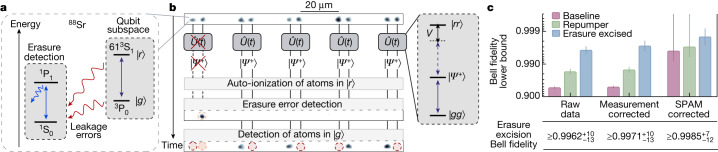
Fig. 1a–b from P. Scholl, A. L. Shaw, R. B.-S. Tsai, R. Finkelstein, J. Choi & M. Endres, "Erasure Conversion in a High-Fidelity Rydberg Quantum Simulator," Nature 622, 273–278 (2023), licensed CC BY 4.0. Panel a: the ⁸⁸Sr qubit subspace (|g⟩, |r⟩) and the auxiliary levels used to detect leakage as erasures. Panel b: the actual blockade-based entangling pulse sequence Û(t) applied to two real atoms.
Blockade condition
The blockade radius is typically 6–18 micrometers depending on n and atomic species, comfortably matching typical tweezer spacing and allowing nearest-neighbor (and next-nearest-neighbor) gates.
Scaling to larger arrays
Multi-qubit gates and native Toffoli gates can be built by exploiting simultaneous blockade among several atoms.
Residual interactions with more distant atoms, known as spectator errors, are a major source of gate infidelity.
Why neutral atoms are a strong platform for quantum computing
The same physics that makes Rydberg atoms hard to control also gives them real structural advantages over other qubit platforms.
Coherence time sets a hard ceiling on how long a qubit can hold quantum information before it decays. Caltech's 2025 cesium tweezer array reached a coherence time of 12.6 seconds[34]H. J. Manetsch, G. Nomura, E. Bataille, X. Lv, K. H. Leung & M. Endres (2025). A Tweezer Array with 6,100 Highly Coherent Atomic Qubits. Nature 647, 60–67. — compared with roughly 70–400 microseconds for today's best superconducting transmons, a gap of five to six orders of magnitude.
Raw coherence time is not the whole story, though: what actually limits an algorithm is coherence time divided by gate duration, the number of operations that fit inside a qubit's useful lifetime. Neutral-atom gates run in hundreds of nanoseconds to a few microseconds, slower than a superconducting qubit's tens-of-nanoseconds gates, so the real advantage in operation count is smaller than the raw coherence numbers alone suggest, though still substantial.
No dilution refrigerator required
Neutral atoms sit in a room-temperature vacuum chamber; only the atoms themselves are laser-cooled to microkelvin temperatures, not the surrounding hardware. Superconducting qubits, by contrast, require the entire chip to operate inside a dilution refrigerator at 10–20 millikelvin — one of the more complex and expensive parts of that platform.
Identical qubits, minimal fabrication variance
Because every atom of a given isotope is physically identical, neutral-atom qubits carry none of the fabrication variance that affects lithographically patterned superconducting circuits, where each Josephson junction differs slightly from its neighbors. This uniformity simplifies calibration as arrays scale to thousands of qubits.
Native multi-qubit gates, demonstrated in hardware
Rydberg blockade also makes native multi-qubit gates possible, not just in theory: in 2019 a Harvard/MIT team demonstrated a genuine three-qubit Toffoli gate directly in hardware, with 95.3% average fidelity across its eight computational basis states[37]H. Levine, A. Keesling, G. Semeghini, A. Omran, T. T. Wang, S. Ebadi, H. Bernien, M. Greiner, V. Vuletić, H. Pichler & M. D. Lukin (2019). Parallel Implementation of High-Fidelity Multiqubit Gates with Neutral Atoms. Phys. Rev. Lett. 123, 170503. — a gate that has to be built from several two-qubit gates on most other platforms.
Analog vs digital quantum modes
One more structural advantage: the same array of atoms can run as a digital gate-based processor or as an analog quantum simulator, each suited to different problems.
In digital mode, atoms are encoded as qubits and a universal gate set is applied sequentially, similar to superconducting or ion-trap computers.
In analog mode, the entire array evolves under a tunable Hamiltonian, which is ideal for studying quantum phases and optimization landscapes.
The Rydberg Hamiltonian is controlled by the global Rabi frequency Ω(t) and detuning δ(t), which define the local field and interaction terms.
Rydberg Ising Hamiltonian
Ising-type Hamiltonians are naturally implemented with pairwise van der Waals interactions between adjacent atoms.
Ising Hamiltonian
XY and other spin models can be engineered by choosing different Rydberg states, laser polarizations, or lattice geometries.
Analog simulation is well suited to finding ground states of combinatorial optimization problems through adiabatic evolution.
Hybrid analog-digital algorithms
Hybrid algorithms combine analog evolution with digital gates, using the best features of both approaches.
Overhead trade-offs
Overhead for converting analog dynamics into digital gates is significant, so native analog execution can outperform gate decomposition for specific problems.
Analog quantum simulation
By tuning global parameters, the atom array becomes a programmable quantum simulator whose phase diagram can be explored interactively.
Analog quantum simulators use the natural Hamiltonian of the system rather than compiled gate sequences.
Changing the Rabi frequency and detuning drives the array across phase boundaries such as ordered, disordered, and crystalline states — as demonstrated on a 256-atom programmable array in 2021.[6]S. Ebadi et al. (2021). Quantum phases of matter on a 256-atom programmable quantum simulator. Nature 595, 227–232.
Rydberg Hamiltonian
Single and multi-qubit gates
Having covered the analog side, the rest of this page turns to the digital, gate-based mode: neutral-atom processors implement rotations with microwaves or Raman beams, and entangling gates through Rydberg pulses.
Single-qubit gates are fast, often below one microsecond, and can be addressed globally or with individual laser beams; the best demonstrated single-qubit fidelity is 99.98%.[34]H. J. Manetsch, G. Nomura, E. Bataille, X. Lv, K. H. Leung & M. Endres (2025). A Tweezer Array with 6,100 Highly Coherent Atomic Qubits. Nature 647, 60–67.
Local addressing uses tightly focused beams to illuminate only one atom while leaving its neighbors unaffected.
CZ gate with Rydberg blockade
The two-qubit CZ gate is the most common entangling gate, using a sequence of Rydberg pulses to accumulate a conditional phase; the best demonstrated two-qubit fidelity is 99.5%, averaged across 60 gates run in parallel.[12]S. J. Evered et al. (2023). High-fidelity parallel entangling gates on a neutral-atom quantum computer. Nature 622, 268–272.
Geometric pulse shapes, such as optimal pulses derived from reverse engineering, can suppress leakage and motional errors.
CZ unitary
Native multi-qubit gates
Native multi-qubit gates such as CCZ and Toffoli are implemented in a single pulse sequence, saving gate count compared to digital decomposition.
Intrinsic error bound
Intrinsic gate errors are bounded by the adiabatic speed limit, which relates the interaction strength and pulse duration to the minimum possible error.
Gate benchmarking with randomized benchmarking and cross-entropy measures helps separate coherent errors from stochastic ones.
Native gate library
Native gates can be used directly in quantum algorithms or decomposed into a universal set of one- and two-qubit gates.
- •Single-qubit rotations — Microwave or Raman pulses around any Bloch-sphere axis.
- •Multi-qubit gates — Native CZ, CCZ, and Toffoli driven by Rydberg blockade.
- •Analog evolution — Continuous Hamiltonian evolution for simulation and optimization.
CZ gate pulse sequence
A controlled-Z gate accumulates a conditional phase by exciting the control atom to a Rydberg state and performing a 2π rotation on the target atom.
The CZ gate applies a π pulse on the control atom, a 2π pulse on the target atom, and a final π pulse on the control atom — the mechanism behind the first two-qubit gates to average 99.5% fidelity in parallel.[12]S. J. Evered et al. (2023). High-fidelity parallel entangling gates on a neutral-atom quantum computer. Nature 622, 268–272.
CZ matrix
When the control atom is in |1⟩, the Rydberg blockade shifts the target atom's 2π pulse, preventing a full return to the ground state and accumulating a π phase.
Pulse sequence
When the control atom is in |0⟩, the target atom completes a full 2π rotation and returns unchanged, leaving no phase.
- π on control — Excites the control atom if it is in the qubit |1⟩ state.
- 2π on target — Returns the target to the ground state, but accumulates a phase if blocked.
- π on control again — Brings the control atom back to its original state.
Geometric phase
The geometric phase is robust because it depends on the area enclosed in the Bloch sphere rather than the exact pulse amplitude.
Optimal pulse shapes reduce the effect of finite blockade strength, motional excitation, and laser noise.
Pulse shape comparison
Square pulses are simple but cause more leakage; smooth optimal pulses keep the population closer to the desired subspace.
The same sequence can be extended to multi-qubit gates by involving several control atoms simultaneously.
Gate error budget
Achieving fault-tolerant gates requires identifying and suppressing every error source, from atomic motion to laser noise and environmental fields.
The intrinsic error of a Rydberg gate is set by the ratio of the interaction strength to the pulse duration, which obeys a quantum speed limit — this is the same error budget characterized in the 2023 demonstration of 99.5% two-qubit fidelity.[12]S. J. Evered et al. (2023). High-fidelity parallel entangling gates on a neutral-atom quantum computer. Nature 622, 268–272.
Minimum intrinsic error
Thermal motion of the atoms causes Doppler shifts and time-varying laser coupling during the gate, converting motional energy into phase errors.
Intrinsic quantum limit
Blackbody radiation from the room-temperature environment can ionize or dephase Rydberg atoms, especially for high n states.
Experimental error sources
Laser intensity and phase noise directly affect the Rabi frequency and must be stabilized below the part-per-thousand level.
- •Doppler shifts — Thermal velocity changes the Doppler shift during the gate and causes time-dependent coupling.
- •Blackbody radiation — Thermal photons drive transitions between Rydberg states and cause spontaneous ionization.
- •Laser noise — Intensity and phase fluctuations of the Rydberg excitation lasers translate directly into pulse-area errors.
- •Spectator interactions — Rydberg excitation of one atom weakly shifts the energy of nearby uninvolved atoms.
- •Stray fields — Electric and magnetic fields from the environment shift Rydberg levels and break blockade conditions.
Error targets for fault tolerance
Spectator atoms near the target qubit experience weak Rydberg shifts and can pick up unwanted phases.
Stray electric and magnetic fields shift Rydberg levels and must be shielded or compensated to maintain gate calibration.
Native multi-qubit gates
Despite those error sources, one structural advantage still stands out: neutral atoms can implement multi-controlled gates directly, reducing the number of pulses and improving algorithm efficiency.
A native three-qubit gate, such as CCZ or Toffoli, can be performed with one Rydberg pulse sequence instead of decomposing into many CNOTs — demonstrated in hardware in 2019 with 95.3% average fidelity across all eight computational basis states.[37]H. Levine, A. Keesling, G. Semeghini, A. Omran, T. T. Wang, S. Ebadi, H. Bernien, M. Greiner, V. Vuletić, H. Pichler & M. D. Lukin (2019). Parallel Implementation of High-Fidelity Multiqubit Gates with Neutral Atoms. Phys. Rev. Lett. 123, 170503.
The resource savings are large: a Toffoli may need fewer than ten pulses natively versus six CNOTs and eight single-qubit gates in digital form.
CCZ with Rydberg blockade
Native multi-qubit gates are especially useful for arithmetic, reversible logic, and quantum error-correction protocols.
Pulse labels in the chart compare the native pulse count to the decomposed count for a representative Toffoli-like circuit.
Array architecture and reconfigurability
The geometry of the atom array is not fixed; it can be reconfigured to match the connectivity required by an algorithm or Hamiltonian.
Static 2D arrays can be generated with spatial light modulators or microlens arrays, producing hundreds of traps with regular spacing.
Acousto-optic deflectors can create moving tweezers that transport atoms between zones, enabling a QCCD-like architecture.
Reconfigurable geometries
Reconfigurable arrays allow all-to-all connectivity for problems that are not local on a fixed grid, such as MaxCut on random graphs.
The QCCD architecture separates storage, entangling, readout, and reservoir zones, so each step is optimized in its own region.
Four-zone QCCD architecture
Atoms can be rearranged during computation to reduce the number of shuttling steps or to place interacting pairs next to each other.
As arrays scale to thousands of atoms, fast imaging and feedback loops must keep track of defect positions and trigger reloads. Array sizes have grown quickly: Atom Computing loaded 1,225 sites in 2023, Pasqal exceeded 1,000 atoms in 2024, USTC assembled a 2,024-atom defect-free array with AI-optimized control in 2025,[39]R. Lin et al. (2025). AI-Enabled Parallel Assembly of Thousands of Defect-Free Neutral Atom Arrays. Phys. Rev. Lett. 135, 060602. and Caltech reached 6,100 highly coherent qubits in a single array the same year.[34]H. J. Manetsch, G. Nomura, E. Bataille, X. Lv, K. H. Leung & M. Endres (2025). A Tweezer Array with 6,100 Highly Coherent Atomic Qubits. Nature 647, 60–67. A 2026 preprint reports trapping roughly 11,000 atoms using a single metasurface in place of bulk optics, though this result has not yet been peer-reviewed.[38]Y. Wang, Z. Zhang, T. Zhang, Y. Liao, H. Wang, Y. Tian, B. Ji, Y. Wu, L. Ma, C. Qing, C. Li, W. Zhang, Y. Huang, W. Zhang, X. Feng, W. Chen & H. Zhai (2026). Trapping 11,000 Atoms in a Tweezer Array Generated by a Single Metasurface. arXiv:2606.02715 (preprint, not yet peer-reviewed).
QCCD shuttling with neutral atoms
QCCD architectures move atoms between specialized zones, combining long storage coherence with high-fidelity entangling regions.
In a QCCD-like neutral-atom processor, atoms are stored in a low-noise storage zone and only shuttled to an entangling zone when a gate is needed — the real architecture pictured below.[10]D. Bluvstein et al. (2023). Logical quantum processor based on reconfigurable atom arrays. Nature 626, 58–65.
This separation protects qubits from the strong Rydberg lasers used during gates and from the heating caused by readout illumination.
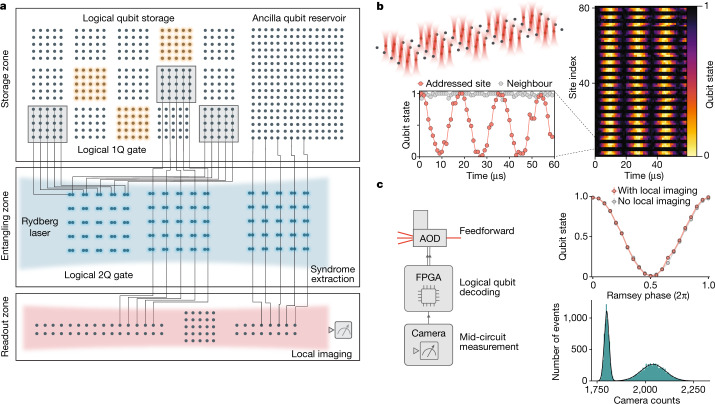
Fig. 1a from D. Bluvstein et al., "Logical Quantum Processor Based on Reconfigurable Atom Arrays," Nature 626, 58–65 (2023), licensed CC BY 4.0. The real zoned architecture used in that experiment: a storage zone for idle qubits, an entangling zone where the Rydberg laser drives gates, and a readout zone for mid-circuit imaging.
QCCD shuttling
Atoms move between zones on a fast, repeated cycle.
Shuttling timing budget
After measurement, spent ancilla atoms can be moved to a reservoir zone and replaced with fresh atoms from a loading zone — a 2025 Harvard/MIT system sustained this cycle at roughly 300,000 atoms per second, keeping a 3,000-qubit array running continuously for over two hours.[35]N.-C. Chiu, T. Trapp, K. Guo, M. Abobeih, J. Stewart, L. Hollerith, A. Stroganov, P. Kalinowski, N. Geim, S. J. Evered, T. Li, X. Lyu, C. Peters, D. Bluvstein, S. Wang, M. Greiner & M. D. Lukin (2025). Continuous Operation of a Coherent 3,000-Qubit System. Nature 646, 1075–1080.
Atom transport~100 µs
Move atom pairs between storage and entangling zones.
Rydberg gate~0.5 µs
CZ or CCZ gate in the entangling zone.
Mid-circuit readout~1 ms
Image, decide, and refill ancilla in the readout zone.
Reconfiguration~1 ms
Rearrange array geometry for the next algorithm step.
Vacuum cell, optics, and control hardware
A neutral-atom processor is built around a vacuum cell, high-NA optics, laser systems, and fast electronics for real-time control.
The vacuum cell maintains an ultra-high-vacuum environment to reduce collisions between trapped atoms and background gas molecules.
High-numerical-aperture objectives sit inside or outside the cell to focus tweezer beams and collect fluorescence photons.
Spatial light modulators and acousto-optic deflectors create and move the tweezer array under software control, but diffraction efficiency and available laser power cap these approaches at roughly ten thousand traps; a 2026 preprint reports replacing them with a single metasurface — a flat, nanostructured optic outside the vacuum cell — to trap roughly 11,000 atoms without a bulk microscope objective.[38]Y. Wang, Z. Zhang, T. Zhang, Y. Liao, H. Wang, Y. Tian, B. Ji, Y. Wu, L. Ma, C. Qing, C. Li, W. Zhang, Y. Huang, W. Zhang, X. Feng, W. Chen & H. Zhai (2026). Trapping 11,000 Atoms in a Tweezer Array Generated by a Single Metasurface. arXiv:2606.02715 (preprint, not yet peer-reviewed).
Rydberg excitation lasers are locked to stable references to maintain narrow linewidth and long coherence during gates.
Magnetic field coils provide quantization fields and allow fast switching for state preparation and addressing.
Vacuum and cryogenic lifetime
Atoms are trapped in a vacuum cell, but residual background gas causes loss. Cryogenic environments can extend the lifetime dramatically.
In a room-temperature vacuum cell, background gas collisions limit the trap lifetime to a few tens of seconds at typical pressures.
Cryogenic environments reduce the partial pressure of all background gases, extending trap lifetimes to hundreds or thousands of seconds.
A cryostat also reduces blackbody radiation on Rydberg atoms, improving gate coherence and lowering ionization rates.
Tweezer lifetime trade-off
The trade-off between trap depth and lifetime is governed by the scattering rate of tweezer photons, which heats the atoms.
Trap lifetime scaling
Deep traps increase photon scattering and shorten lifetime; shallow traps require colder atoms but live longer.
Control and feedback chain
None of the hardware described above runs itself: real-time control, waveform generation, and image analysis coordinate every step of the experiment from circuit to measurement.
The user circuit is compiled into a sequence of microwave, Raman, and Rydberg pulses with precise timing and phase.
A scheduler reorders operations to minimize shuttling and maximize parallel gate execution across the array.
FPGAs and GPUs generate waveforms and analyze fluorescence images in real time, enabling fast feedback and mid-circuit correction.
Real-time timing requirements
Camera frames are processed to identify which atoms are present, which have been lost, and which must be replaced from a reservoir.
The feedback loop is essential for fault tolerance, allowing erasure errors to be detected and corrected before they propagate.
Cooling, imaging, and mid-circuit detection
Fluorescence imaging reads out qubit states and can detect atom loss, enabling mid-circuit measurement and conditional reloading.
A near-resonant laser scatters photons from atoms in one qubit state while the other state remains dark.
Collected photons are imaged onto a high-efficiency camera with single-atom resolution, allowing each site to be read independently.
Photon recoil energy
The recoil energy from scattered photons can heat atoms out of shallow traps, so readout pulses must be brief and carefully tuned.
Fluorescence imaging
Fluorescence images reveal whether an atom is present or lost, making atom loss a detectable erasure error rather than a silent bit-flip.
Mid-circuit readout can measure ancilla qubits during computation and condition future operations on the outcome.
Mid-circuit measurement
After readout, lost or measured atoms can be replaced from a reservoir and recooled, restoring the array for the next step.
This cycle of image, decide, and refill is what makes neutral-atom QCCD architectures possible.
Mid-circuit readout and reloading
That imaging cycle has a specific, powerful use during a live computation: measuring ancilla qubits mid-circuit, then replacing them with fresh atoms, converts loss into a detectable erasure error.
Mid-circuit readout begins by moving an atom to a readout zone or splitting it into two separate traps based on its qubit state.
A fluorescence image reveals the state, while the same process can confirm whether the atom has survived.
If the atom is lost, a fresh atom is moved from a reservoir and prepared in the desired initial state — a 2025 system sustained this cycle at roughly 300,000 atoms per second.[35]N.-C. Chiu, T. Trapp, K. Guo, M. Abobeih, J. Stewart, L. Hollerith, A. Stroganov, P. Kalinowski, N. Geim, S. J. Evered, T. Li, X. Lyu, C. Peters, D. Bluvstein, S. Wang, M. Greiner & M. D. Lukin (2025). Continuous Operation of a Coherent 3,000-Qubit System. Nature 646, 1075–1080.
Because loss is detected and corrected, the effective error rate for error correction is lower than the raw physical error rate: a 2023 demonstration converted about a third of physical errors into detected erasures in real time, reaching 98.0% two-qubit gate fidelity with an error-detection failure rate below 10⁻⁵ on surviving qubits.[40]S. Ma, G. Liu, P. Peng, B. Zhang, S. Jandura, J. Claes, A. P. Burgers, G. Pupillo, S. Puri & J. D. Thompson (2023). High-Fidelity Gates and Mid-Circuit Erasure Conversion in an Atomic Qubit. Nature 622, 279–284.
Mid-circuit measurement is central to syndrome extraction in surface-code and color-code implementations.
Surface code decoding with atom loss
Neutral-atom loss is a detectable erasure error; loss-aware decoders can turn it into a significant advantage for surface-code error correction.
Surface codes detect errors by measuring stabilizers on a lattice of data and ancilla qubits.
Conventional decoders assume only Pauli errors and may misinterpret an atom loss as an X or Z error.
Below fault-tolerance threshold2.14×
From a 2026 demonstration on 448 atoms combining atom-loss detection with machine-learning decoding (see citation above).
Machine-learning decoders
Loss-aware decoders use the fact that the missing qubit position is known, matching erasures directly to edges in the decoding graph — the basis of erasure conversion, demonstrated in 2023 by converting Rydberg decay errors into known-location erasures in real time.[40]S. Ma, G. Liu, P. Peng, B. Zhang, S. Jandura, J. Claes, A. P. Burgers, G. Pupillo, S. Puri & J. D. Thompson (2023). High-Fidelity Gates and Mid-Circuit Erasure Conversion in an Atomic Qubit. Nature 622, 279–284.
Including loss information improves the effective error threshold and reduces the logical error rate per round; a 2026 demonstration on 448 atoms combining atom-loss detection with machine-learning decoding ran 2.14 times below the surface-code fault-tolerance threshold.[19]D. Bluvstein et al. (2026). A Fault-Tolerant Neutral-Atom Architecture for Universal Quantum Computation. Nature 649, 39–46.
Quantum error correction with neutral atoms
Zooming out from that specific decoding advantage, the broader picture is that neutral-atom platforms can implement quantum error correction using surface codes, color codes, and transversal logical gates.
The long coherence time and high connectivity of neutral atoms make them well suited for stabilizer codes.
Surface codes require only nearest-neighbor gates and have a high error threshold, but logical operations can be complex.
Surface-code implementation
Color codes and other LDPC codes may need long-range interactions, which neutral atoms can provide through reconfigurable shuttling.
Mid-circuit measurement enables syndrome extraction and ancilla replacement without destroying the logical state.
Logical operations
Native multi-qubit gates can simplify logical circuits, especially for non-Clifford operations and magic-state distillation.
Universal fault tolerance
The first neutral-atom logical qubits are being demonstrated by integrating shuttling, readout, and high-fidelity gates: Harvard, QuEra, and MIT encoded 228 physical atoms into 48 logical qubits and ran hundreds of logical operations in 2023,[10]D. Bluvstein et al. (2023). Logical quantum processor based on reconfigurable atom arrays. Nature 626, 58–65. Microsoft and Atom Computing reported 24 entangled logical qubits on a commercial system in 2024, and a 2026 follow-up scaled to 448 atoms with logical error correction running below the fault-tolerance threshold.[19]D. Bluvstein et al. (2026). A Fault-Tolerant Neutral-Atom Architecture for Universal Quantum Computation. Nature 649, 39–46.
Deep circuits and logical qubits
Building a useful quantum computer requires stacking many error-corrected qubits and running deep logical circuits efficiently.
Deep circuits consist of thousands of logical gates, each requiring a physical implementation of CNOTs, Hadamards, and T gates.
Logical qubits are encoded in many physical qubits so that errors stay below the threshold throughout the computation.
Transversal gates are especially valuable because they do not spread errors between physical qubits within a code block.
Teleportation and lattice surgery are used to move logical information between code blocks and to perform multi-qubit logical operations.
Transversal gates
The Steane code demonstrates many concepts of fault tolerance, including transversal Clifford gates and syndrome extraction.
Logical teleportation
T gates are usually implemented through magic-state distillation, consuming many ancilla qubits to produce high-fidelity magic states.
Steane code
Concatenated codes and surface codes with different distances are chosen based on the logical error budget of the target algorithm.
Native multi-qubit gates in neutral atoms can reduce the depth of logical circuits compared to standard two-qubit decompositions.
High-rate logical clock
A high logical clock rate is essential for practical algorithms; it depends on the physical gate speed and the decoding latency.
[[16,6,4]] code
The [[16,6,4]] code and other small block codes are studied as testbeds for transversal gates and decoding strategies.
Scaling logical qubits
Scaling beyond a few logical qubits requires careful management of ancilla consumption, routing, and classical feedforward. The main obstacles cited in the current literature are real-time decoding latency as code distance grows, optical crosstalk and laser-power limits as tweezer arrays get denser, and the throughput of atom reloading between shots.
Neutral-atom systems are aiming to demonstrate tens of logical qubits and deep logical circuits in the near term — QuEra has outlined a roadmap toward more than 1,000 logical qubits by 2028–2029, though this remains a target rather than an achieved result.
Videos & Talks
Curated videos explaining neutral-atom quantum computing from first principles to industrial roadmaps.
Quantum Computing with Neutral Atoms
~20 minAn introduction to how neutral atoms are trapped, manipulated, and used for quantum computing and simulation.
What Is Rydberg Blockade?
~2 minQuEra's short explainer on the Rydberg blockade mechanism that makes fast, high-fidelity entangling gates possible.
Gate-Based Quantum Computing with Neutral Atoms
~31 minQuEra's Pedro Lopes gives a technical talk on the neutral-atom gate model, presented at IBM's Quantum Technical Exchange.
Logical Quantum Processor with Neutral Atom Arrays
~89 minMikhail Lukin (Harvard) on building and operating logical qubits with reconfigurable neutral-atom arrays, part I of a two-part lecture at IPAM.
References
Selected papers and reviews covering neutral-atom quantum computing, Rydberg gates, and error correction.
[1]
M. Saffman, T. G. Walker & K. Mølmer, Quantum information with Rydberg atoms, Rev. Mod. Phys. 82, 2313–2363 (2010).
[2]
H. Labuhn et al., Tunable two-dimensional arrays of single Rydberg atoms for realizing quantum Ising models, Nature 534, 667–670 (2016).
[3]
H. Weimer et al., Rydberg atoms: a natural quantum simulator, Nat. Phys. 6, 382–388 (2010).
[4]
M. Endres et al., Atom-by-atom assembly of defect-free one-dimensional cold atom arrays, Science 354, 1024–1027 (2016).
[5]
D. Barredo et al., Atom-by-atom assembly of defect-free one-dimensional cold atom arrays, Science 354, 1021–1023 (2016).
[6]
S. Ebadi et al., Quantum phases of matter on a 256-atom programmable quantum simulator, Nature 595, 227–232 (2021).
[7]
S. de Léséleuc et al., Single-atom addressing in tightly packed two-dimensional arrays of optically trapped neutral atoms, Phys. Rev. Lett. 120, 113603 (2018).
[8]
M. Morgado & D. Porras, Universal quantum computing with atomic bosonic qubits, New J. Phys. 23, 043041 (2021).
[9]
P. Scholl et al., Quantum simulation and computing with Rydberg-interacting qubits, Appl. Phys. Rev. 9, 021303 (2022).
[10]
D. Bluvstein et al., Logical quantum processor based on reconfigurable atom arrays, Nature 626, 58–65 (2023).
[11]
T. M. Graham et al., Demonstration of multi-qubit entanglement and algorithms on a programmable neutral atom quantum computer, Nature 604, 457–462 (2022).
[12]
S. J. Evered et al., High-fidelity parallel entangling gates on a neutral-atom quantum computer, Nature 622, 268–272 (2023).
[13]
I. Cong, H. Levine & N. P. de Leon, Hardware-efficient error-corrected quantum memories with neutral atoms, arXiv:2308.06348 (2023).
[14]
A. D. Challis, M. A. Perlin & D. Bluvstein, Computational architecture for fault-tolerant photonic quantum computing, Nat. Phys. 20, 85–92 (2024).
[15]
QuEra Computing, QuEra Aquila: a 256-qubit neutral-atom quantum computer, QuEra Technical Documentation (2024).
[16]
Pasqal, Pasqal QPU roadmap and neutral-atom analog quantum computing, Pasqal Technical Whitepaper (2024).
[17]
L. Henriet et al., Quantum computing with neutral atoms, Quantum 4, 327 (2020).
[18]
M. Saffman, Quantum computing with atomic qubits and Rydberg interactions: Progress and challenges, J. Phys. B: At. Mol. Opt. Phys. 49, 202001 (2016).
[19]
D. Bluvstein et al., A Fault-Tolerant Neutral-Atom Architecture for Universal Quantum Computation, Nature 649, 39–46 (2026).
[20]
H. Levine et al., High-fidelity control and entanglement of Rydberg-atom qubits, Phys. Rev. Lett. 121, 123603 (2018).
[21]
D. Jaksch et al., Fast quantum gates for neutral atoms, Phys. Rev. Lett. 85, 2208–2211 (2000).
[22]
J. Preskill, Quantum computing in the NISQ era and beyond, Quantum 2, 79 (2018).
[23]
D. Isenhower et al., Demonstration of a neutral atom controlled-NOT quantum gate, Phys. Rev. Lett. 104, 010503 (2010).
[24]
K. M. Maller et al., Rydberg-blockade controlled-not gate and entanglement in a two-atom ensemble, Phys. Rev. A 92, 022336 (2015).
[25]
E. Dennis, A. Kitaev, A. Landahl & J. Preskill, Topological quantum memory, J. Math. Phys. 43, 4452–4505 (2002).
[26]
A. G. Fowler, M. Mariantoni, J. M. Martinis & A. N. Cleland, Surface codes: Towards practical large-scale quantum computation, Phys. Rev. A 86, 032324 (2012).
[27]
S. Bravyi & A. Kitaev, Universal quantum computation with ideal Clifford gates and noisy ancillas, Phys. Rev. A 71, 022316 (2005).
[28]
M. A. Nielsen & I. L. Chuang, Quantum Computation and Quantum Information, Cambridge University Press (2000).
[29]
M. D. Lukin, M. Fleischhauer, R. Cote, L. M. Duan, D. Jaksch, J. I. Cirac & P. Zoller, Dipole Blockade and Quantum Information Processing in Mesoscopic Atomic Ensembles, Phys. Rev. Lett. 87, 037901 (2001).
[30]
E. Urban, T. A. Johnson, T. Henage, L. Isenhower, D. D. Yavuz, T. G. Walker & M. Saffman, Observation of Rydberg Blockade Between Two Atoms, Nature Physics 5, 110–114 (2009).
[31]
A. Gaëtan, Y. Miroshnychenko, T. Wilk, A. Chotia, M. Viteau, D. Comparat, P. Pillet, A. Browaeys & P. Grangier, Observation of Collective Excitation of Two Individual Atoms in the Rydberg Blockade Regime, Nature Physics 5, 115–118 (2009).
[32]
T. Wilk, A. Gaëtan, C. Evellin, J. Wolters, Y. Miroshnychenko, P. Grangier & A. Browaeys, Entanglement of Two Individual Neutral Atoms Using Rydberg Blockade, Phys. Rev. Lett. 104, 010502 (2010).
[33]
H. Bernien, S. Schwartz, A. Keesling, H. Levine, A. Omran, H. Pichler, S. Choi, A. S. Zibrov, M. Endres, M. Greiner, V. Vuletić & M. D. Lukin, Probing Many-Body Dynamics on a 51-Atom Quantum Simulator, Nature 551, 579–584 (2017).
[34]
H. J. Manetsch, G. Nomura, E. Bataille, X. Lv, K. H. Leung & M. Endres, A Tweezer Array with 6,100 Highly Coherent Atomic Qubits, Nature 647, 60–67 (2025).
[35]
N.-C. Chiu, T. Trapp, K. Guo, M. Abobeih, J. Stewart, L. Hollerith, A. Stroganov, P. Kalinowski, N. Geim, S. J. Evered, T. Li, X. Lyu, C. Peters, D. Bluvstein, S. Wang, M. Greiner & M. D. Lukin, Continuous Operation of a Coherent 3,000-Qubit System, Nature 646, 1075–1080 (2025).
[36]
L. Béguin et al., Direct Measurement of the van der Waals Interaction between Two Rydberg Atoms, Phys. Rev. Lett. 110, 263201 (2013).
[37]
H. Levine, A. Keesling, G. Semeghini, A. Omran, T. T. Wang, S. Ebadi, H. Bernien, M. Greiner, V. Vuletić, H. Pichler & M. D. Lukin, Parallel Implementation of High-Fidelity Multiqubit Gates with Neutral Atoms, Phys. Rev. Lett. 123, 170503 (2019).
[38]
Y. Wang, Z. Zhang, T. Zhang, Y. Liao, H. Wang, Y. Tian, B. Ji, Y. Wu, L. Ma, C. Qing, C. Li, W. Zhang, Y. Huang, W. Zhang, X. Feng, W. Chen & H. Zhai, Trapping 11,000 Atoms in a Tweezer Array Generated by a Single Metasurface, arXiv:2606.02715 (preprint, not yet peer-reviewed) (2026).
[39]
R. Lin et al., AI-Enabled Parallel Assembly of Thousands of Defect-Free Neutral Atom Arrays, Phys. Rev. Lett. 135, 060602 (2025).
[40]
S. Ma, G. Liu, P. Peng, B. Zhang, S. Jandura, J. Claes, A. P. Burgers, G. Pupillo, S. Puri & J. D. Thompson, High-Fidelity Gates and Mid-Circuit Erasure Conversion in an Atomic Qubit, Nature 622, 279–284 (2023).
[41]
P. Scholl, A. L. Shaw, R. B.-S. Tsai, R. Finkelstein, J. Choi & M. Endres, Erasure Conversion in a High-Fidelity Rydberg Quantum Simulator, Nature 622, 273–278 (2023).
Want to see how it compares?
Each hardware platform makes different tradeoffs. See how neutral-atom qubits stack up against superconducting qubits, trapped ions, and photonic qubits.
Browse All Platforms